Guides
Home cleaning cash flow basics for owners who hate spreadsheets
Home cleaning bookkeeping set up properly: a chart of accounts by service line, the weekly cash routine, and the collection gap that funds itself out of your pocket.
What to take away
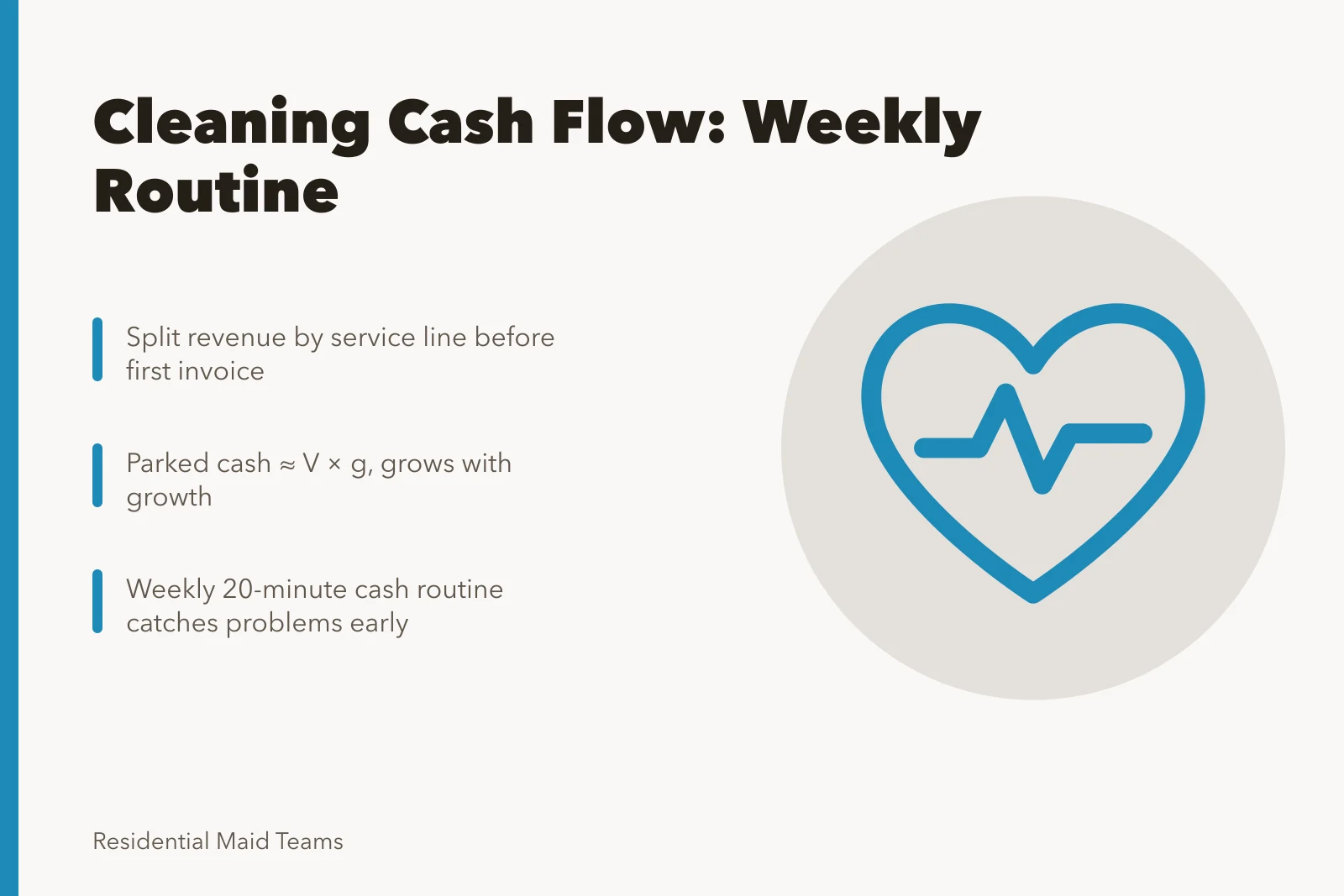
- Set up the chart of accounts by service line before the first invoice. Retrofitting it means a year of records you cannot ask questions of.
- Revenue is not cash. Payroll runs on a fixed cycle and customer payment does not, and the gap between them is money permanently parked in the business.
- Run a weekly cash routine of about twenty minutes. It catches problems while they are still small enough to fix.
- Separate the business bank account on day one, and never pay a personal expense from it.
- Keep the operational record and the accounting record from the same event, so the books and the schedule cannot disagree.
Tax treatment, entity choice, deductibility and payroll obligations depend on your jurisdiction and circumstances. Set them up with an accountant. Nothing here is tax advice.
The chart of accounts, built for questions you will ask
A chart of accounts is a set of questions you will be able to answer later. Design it around the ones that matter in this trade.
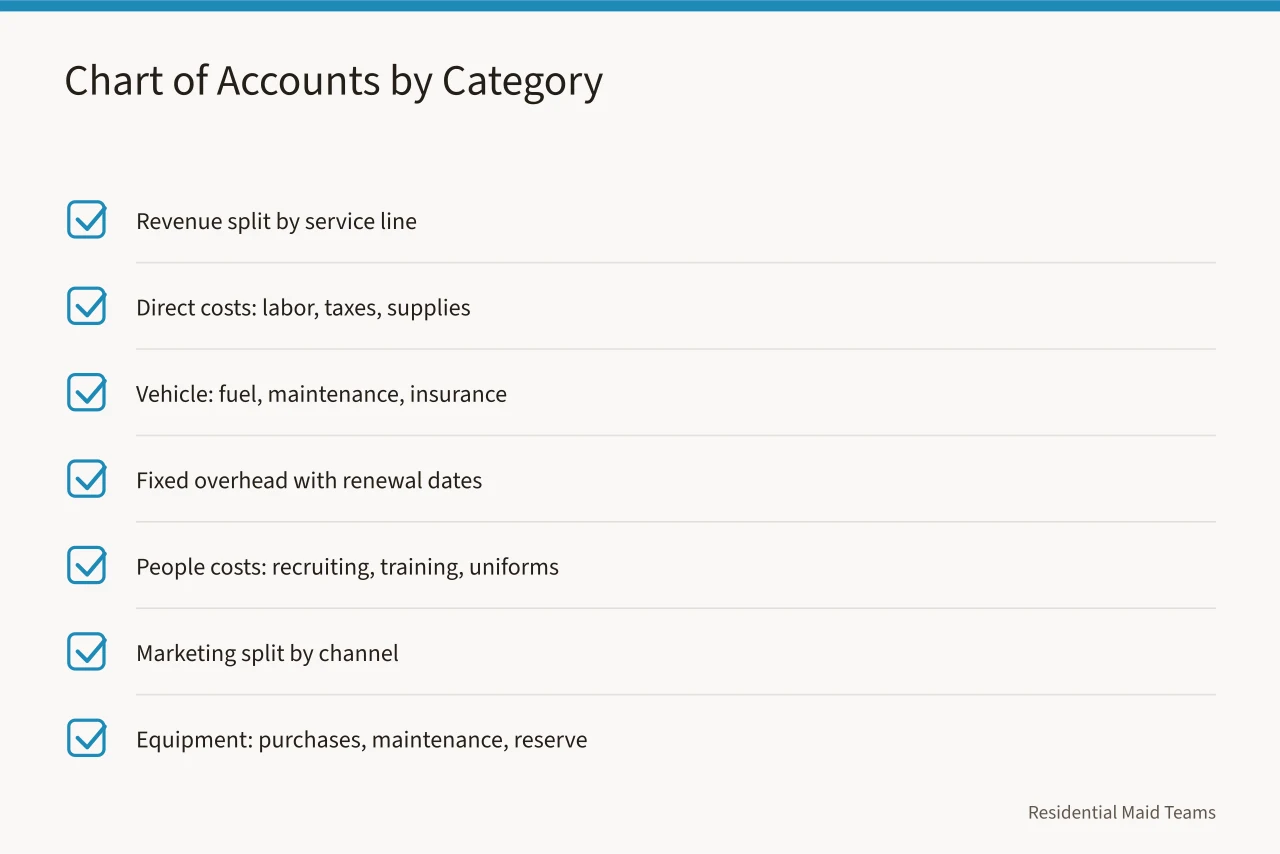
Revenue, split by service line: recurring maintenance, first cleans, deep cleans, move out and move in, specialty work, add ons. Without this split you can see that the company made money and never learn which part of it did.
Direct costs, split the same way where possible: field labor, payroll taxes, workers' compensation, supplies and consumables, laundry, subcontracted work.
Vehicle, separately: fuel, maintenance, insurance, financing. It is large enough in a cleaning company to deserve its own view.
Fixed overhead: general liability and bonding, registrations and renewals, software, phone, storage, accounting, office. The renewal-driven items line up with the recurring compliance costs that recur, so tag them with their renewal dates.
People costs outside direct labor: recruiting, training hours, uniforms. These are where turnover shows up in the books, and grouping them makes the cost of payroll and training costs visible rather than buried.
Marketing, split by channel, so cost per acquired customer is computable.
Equipment: purchases, maintenance, and a replacement reserve if you keep one.
The tax authority is deliberately flexible about your recordkeeping system but clear on what it must show. The Internal Revenue Service: What kind of records should I keep? guidance says a business may pick a method that clearly shows income and expenses.
It must be supported by documents for purchases, sales, payroll and assets. Choose the method with an accountant, then keep it consistently.
Cash is the thing that ends companies
Profitable cleaning companies run out of cash. The mechanism is always the same.
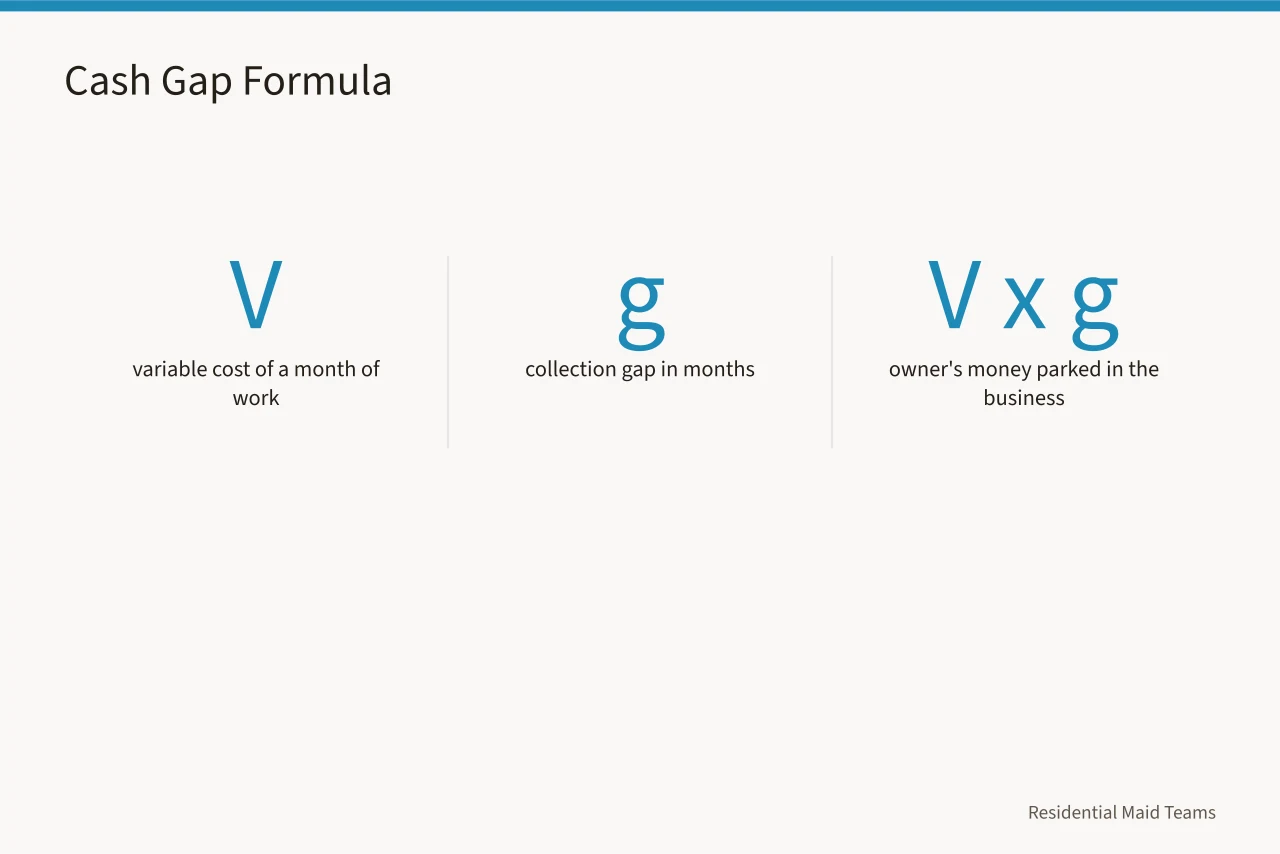
Let V be the variable cost of a month of work, mostly labor and supplies, and g be the collection gap in months: the average delay between performing a visit and having the money. The amount of your own money permanently parked inside the business is roughly V x g, and it grows every time you grow.
Payroll runs weekly or biweekly. Card payments settle in days. Property manager and commercial invoices settle on their own schedule, which is not yours. A month where two large clients pay late is not unusual, and it is not survivable without a reserve.
Three things reduce g directly.
- Charge recurring residential work on the day of service, by card on file. This is normal in the trade and removes the gap almost entirely for the largest part of your revenue.
- Invoice commercial and property manager work the same day, with terms stated at the contract rather than at the invoice.
- Chase on a schedule rather than when you notice. A short, polite, automatic sequence collects more than an occasional awkward call.
The weekly routine
Twenty minutes, same day each week. This is the single highest-return administrative habit available to a small cleaning company.
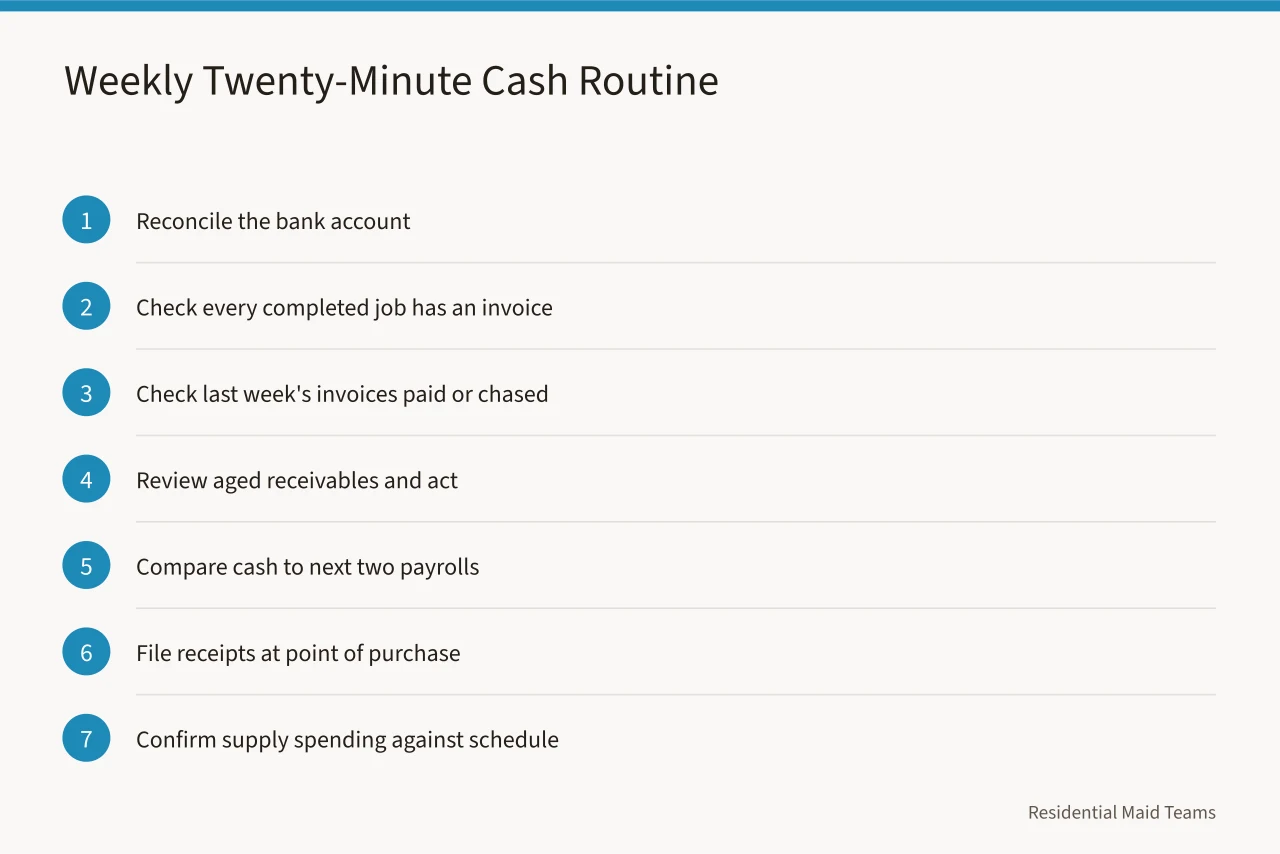
- Reconcile the bank account.
- Check that every completed job has an invoice.
- Check that every invoice sent last week has been paid or chased.
- Review the aged receivables list and act on anything past terms.
- Look at cash on hand against the next two payroll runs.
- File receipts. Photograph them at the point of purchase rather than collecting them in a vehicle.
- Confirm supply spending against what the schedule actually consumed.
Step five is the one that turns a surprise into a decision. Knowing on a Monday that payroll in three weeks is tight gives you options that Friday afternoon does not.
The monthly close
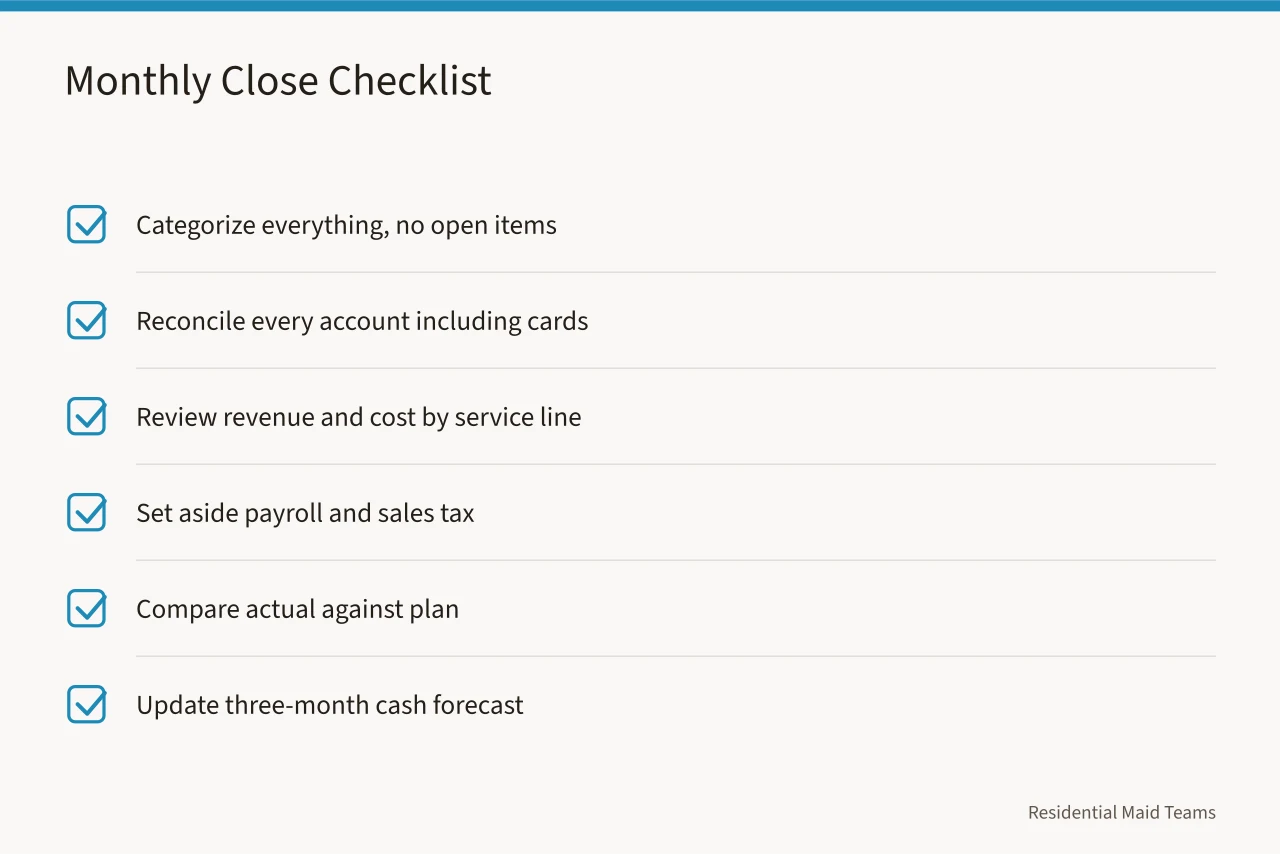
- Categorize everything, with no uncategorized transactions left open.
- Reconcile every account, including cards.
- Review revenue and direct cost by service line.
- Check payroll taxes and any sales tax obligation are set aside rather than spent.
- Compare actual against your plan and write one sentence about the largest variance.
- Update the cash forecast for the next three months.
That last item is where the tax problem is avoided. Money set aside for payroll taxes or sales tax is not working capital, and a business that spends it is borrowing from an authority that does not negotiate.
Money set aside for payroll taxes or sales tax is not working capital. A business that spends it has borrowed from an authority that does not negotiate, and the discovery is always late.
Separation, from day one
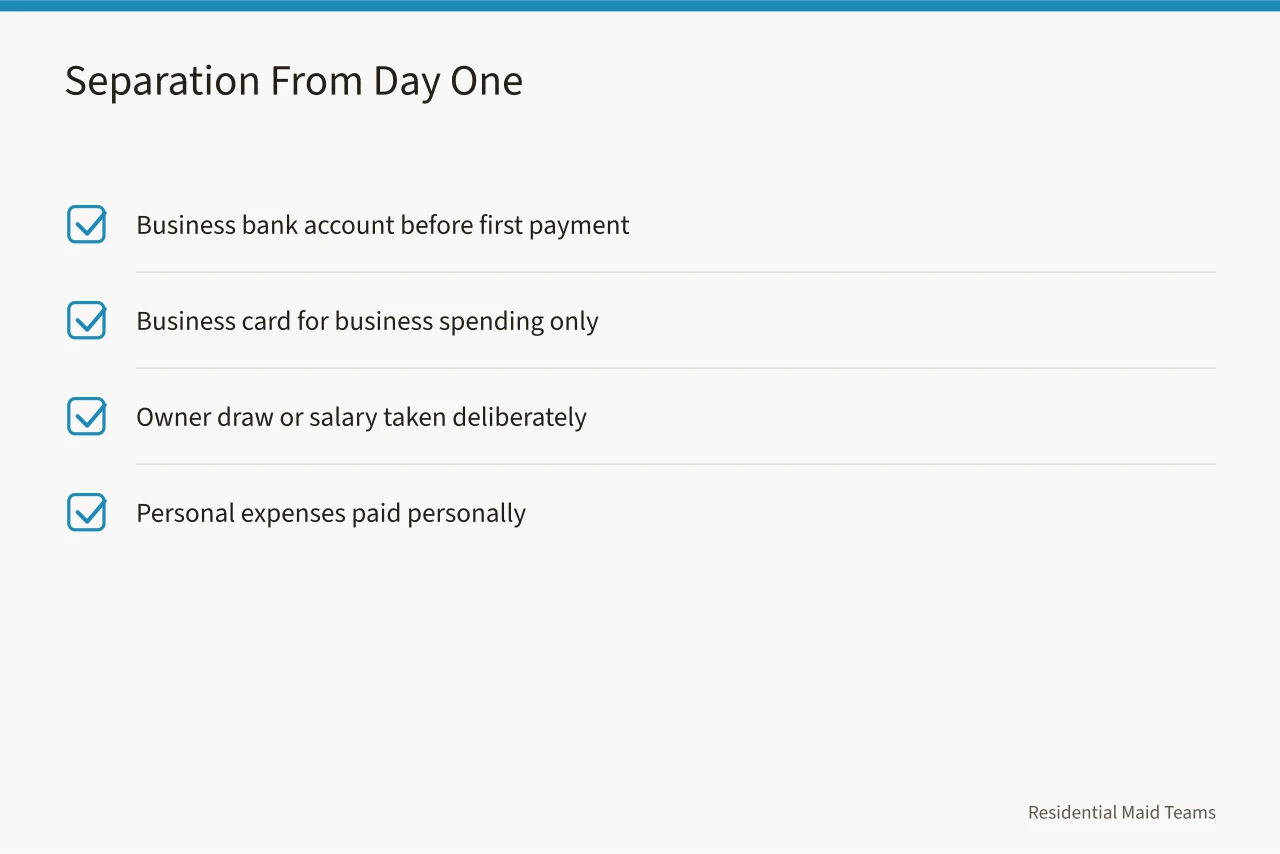
- A business bank account, opened before the first payment.
- A business card for business spending, and nothing else on it.
- An owner draw or salary, taken deliberately, recorded as such.
- Personal expenses paid personally, always.
The reason is not tidiness. Mixed accounts make the books unusable for management, complicate tax preparation, and in some circumstances weaken the separation an entity is supposed to provide. Ask an attorney about the last point for your own structure.
Protecting the records
A cleaning company's financial system sits next to customer addresses, access codes and schedules showing when homes are empty. Bookkeeping security is therefore not a separate topic.
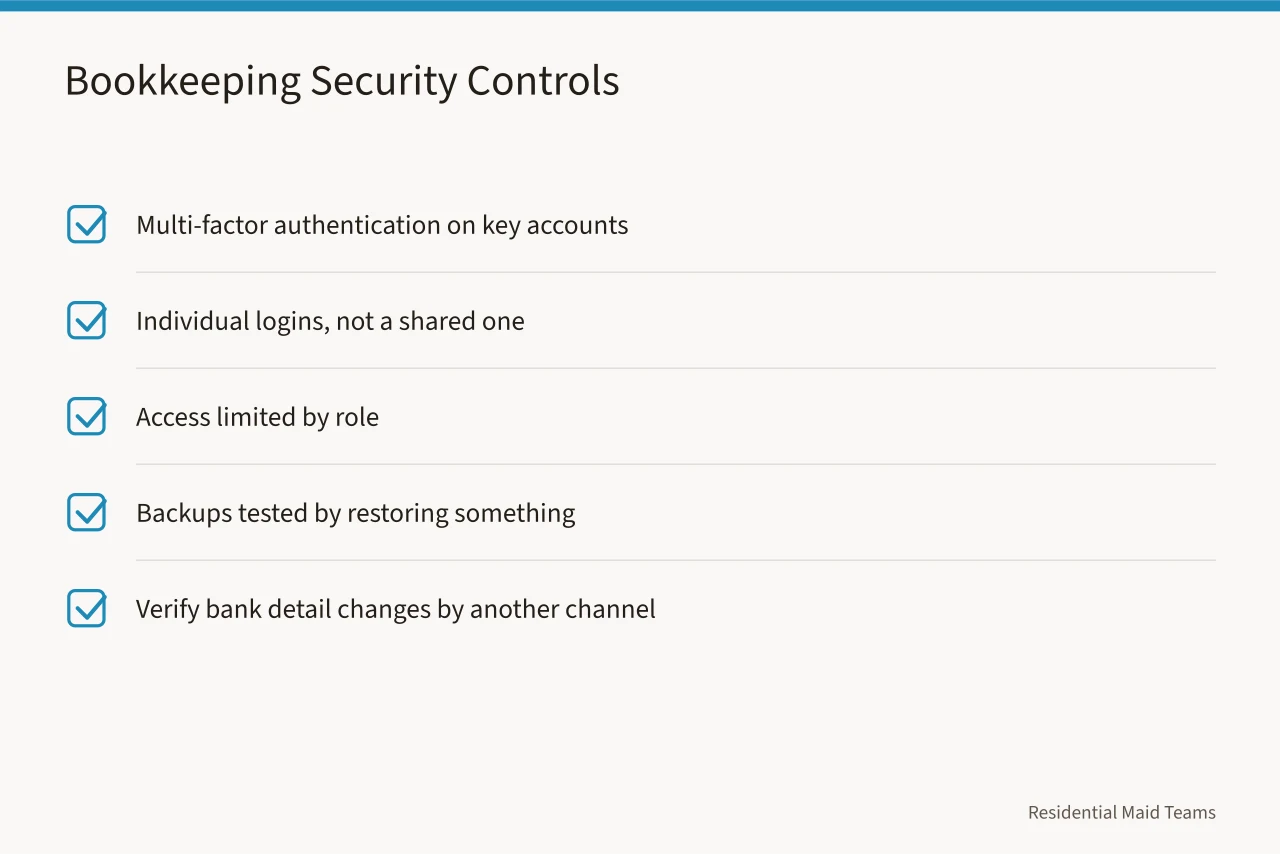
Practical controls: multi-factor authentication on the accounting system, the bank and the email account that can reset both; individual logins rather than a shared one; access limited by role; and backups you have actually tested by restoring something.
The National Institute of Standards and Technology: NIST Small Business Quick-Start Guides set out steps in an order a small company can follow.
The Cybersecurity and Infrastructure Security Agency: Cyber Guidance for Small Businesses covers controls that stop the most common incidents. These include payment redirection fraud, which targets small service businesses through compromised email.
One specific habit is worth adopting: verify any change to bank details for a supplier or a payroll recipient by a channel other than the message that requested it.
Bookkeeping that feeds decisions
The books are only useful if they answer operational questions. Three habits make them do so.
- A service code on every job, applied at booking, carried into the invoice and the ledger.
- Supplies allocated per visit rather than lumped monthly.
- One event producing both records. The job record and the accounting entry should come from the same capture, which is a design property of the bookkeeping and reporting system rather than a discipline you impose weekly.
With those in place you can answer the questions that decide the business: which service line earns its labor hours, what a customer is worth, and whether growth is improving margin or consuming it. Whether the mix you are selling suits the cleaning business market you chose is a question the books can settle rather than an opinion.
Common questions
Do I need an accountant if I use software?
Software records; an accountant decides. Entity choice, payroll setup, tax positions and anything consequential need professional advice. Many owners do their own weekly routine and use an accountant quarterly.
Cash basis or accrual?
That is a decision with tax and reporting consequences that depend on your situation and jurisdiction. Ask an accountant. What matters operationally is that you understand the cash position regardless of which basis the books use.
How much cash reserve should a cleaning company hold?
Enough to cover fixed costs and payroll through a realistic bad month, sized from your own V x g rather than from a general rule. Compute it, then decide how much of it you can actually fund.
What is the most common bookkeeping mistake in this trade?
Treating supplies and vehicle costs as overhead rather than allocating them to jobs. It makes every service line look equally profitable, which is never true.