Guides
Home cleaning demand signals to watch in 2027
No demand forecast appears here. A monitoring routine instead: six signals to watch for home cleaning trends, where each comes from, and what to do when one moves.
What to take away
- No forecast is given on this page. Nobody can tell you what demand will do in your area, and a confident number would be invented.
- What is useful is a monitoring routine: six signals, each with a source you can check yourself, reviewed on a schedule.
- Your own inquiry data is the earliest and most reliable signal you have. It moves before any published statistic does.
- Distinguish a shift in demand from a shift in what customers expect. The second is more common and needs a different response.
- Decide in advance what you will do if a signal moves, so the decision is not made in a month when it is already urgent.
Nothing here states a growth rate, a market size or a statistic. Every source named is one you check for your own area, and the figures you find carry their own dates and caveats.
Why no forecast
Demand forecasts for a local service trade fail for a structural reason: the thing being forecast is national and the thing you experience is a few square miles.
A national shift in household spending tells you almost nothing about whether the two hundred homes in your cluster will buy more or fewer visits next year. Local employment, local housing turnover, local competition and your own reliability matter more, and none of them appear in a published forecast.
So the useful skill is not reading forecasts. It is watching a small number of signals that move early, and knowing what you will do when one of them does.
The six signals
1. Your own inquiry volume and mix. The earliest indicator you have. Track inquiries per week by source and by service, and watch the mix as well as the level. A shift from recurring inquiries toward one-time deep cleans is a demand signal about household budgets, and it appears months before anything published.
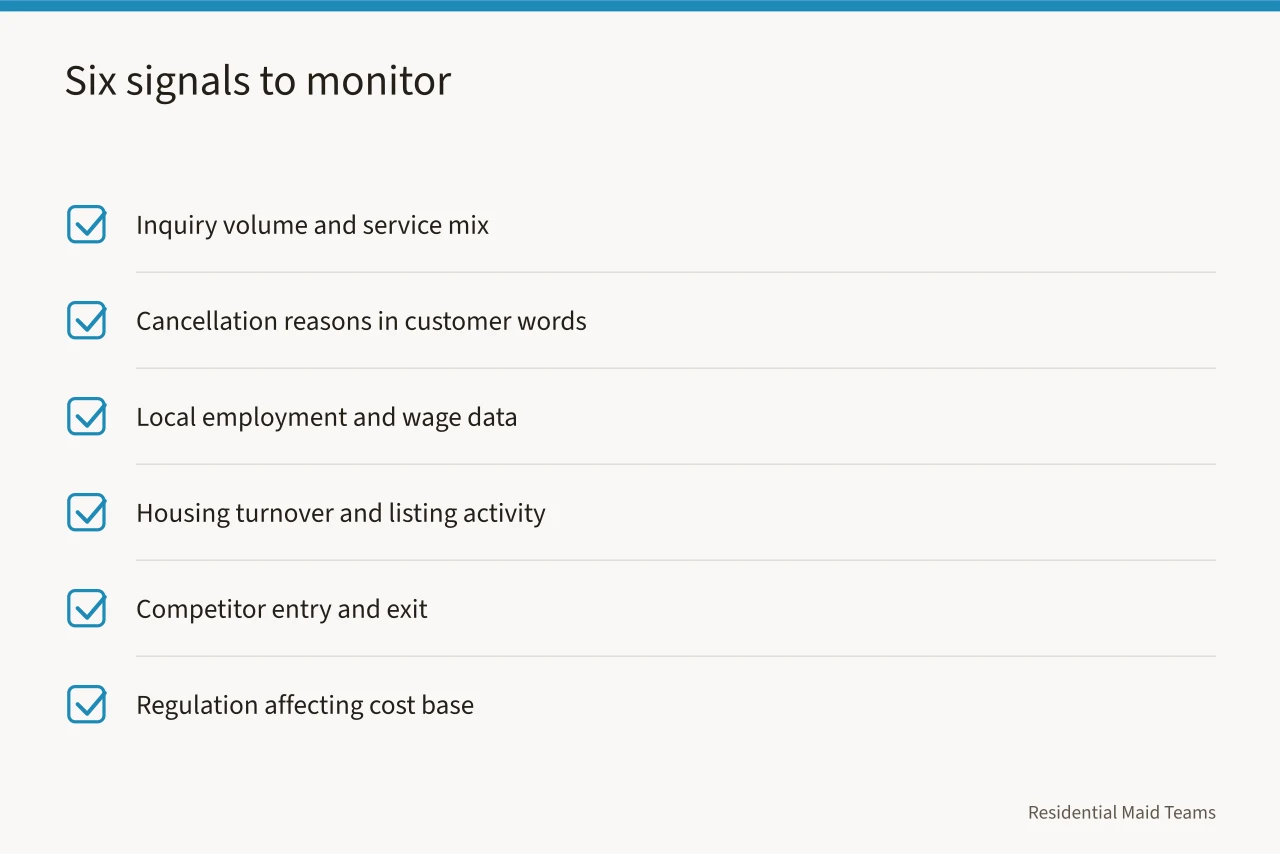
2. Cancellation reasons. Capture a reason for every cancellation, in the customer's words. Cancellations for cost are a different signal from cancellations for a move, and both are different from dissatisfaction. This is your most honest read on whether the market is tightening.
3. Local employment and wages. Two effects, in opposite directions. Employment growth raises demand for household services and simultaneously makes cleaners harder to recruit. Watch both sides using area occupational data such as the U.S. Bureau of Labor Statistics: Occupational Employment and Wage Statistics Tables, which reports wage and employment levels by occupation and metropolitan area.
4. Housing turnover. Sales and rentals in your area drive move out and move in work directly, and they create recurring customers at the moment a household reorganizes. Local listing activity is a leading indicator of that part of your business.
5. Competitive entry and exit. Watch who appears and who stops answering. Exits create available customers and available cleaners at the same time, which is the most actionable local signal there is.
6. Regulatory movement. Changes to worker classification tests, wage and hour rules, workers' compensation thresholds or the tax treatment of services all change your cost base rather than your demand. Track regulatory changes worth tracking through the agencies themselves rather than through trade commentary.
Act on what appears in your own records. A national story that has not shown up in your inquiry data is not yet your problem, and responding to it early is expensive.
Demand versus expectation
Two different things get called a trend, and confusing them produces the wrong response.
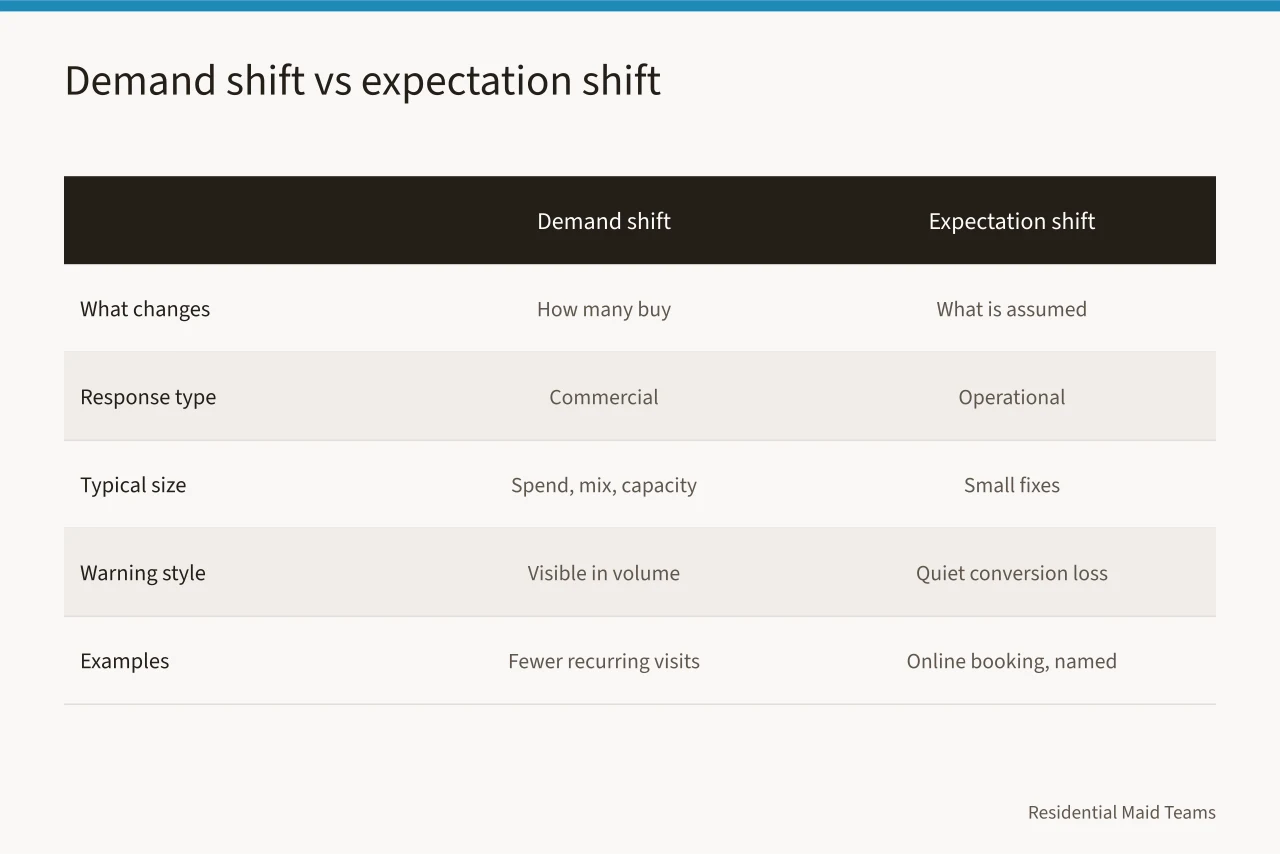
A demand shift changes how many households buy, or how often. The response is commercial: adjust marketing spend, adjust the service mix, adjust capacity.
An expectation shift changes what buyers assume is included. Booking online rather than by phone. Faster responses. Clearer scopes. Requests about products used in homes with children, pets or allergies. Wanting to know who is coming before they arrive.
Expectation shifts are more common, cheaper to answer, and more dangerous to ignore because they degrade conversion quietly, not with announcements. The response is operational and often small: a booking form, a named cleaner in the confirmation, a published scope, a faster reply.
Most of it lives in shifts in how customers search and in the delivery behind it.
The monitoring routine
Quarterly, an hour.
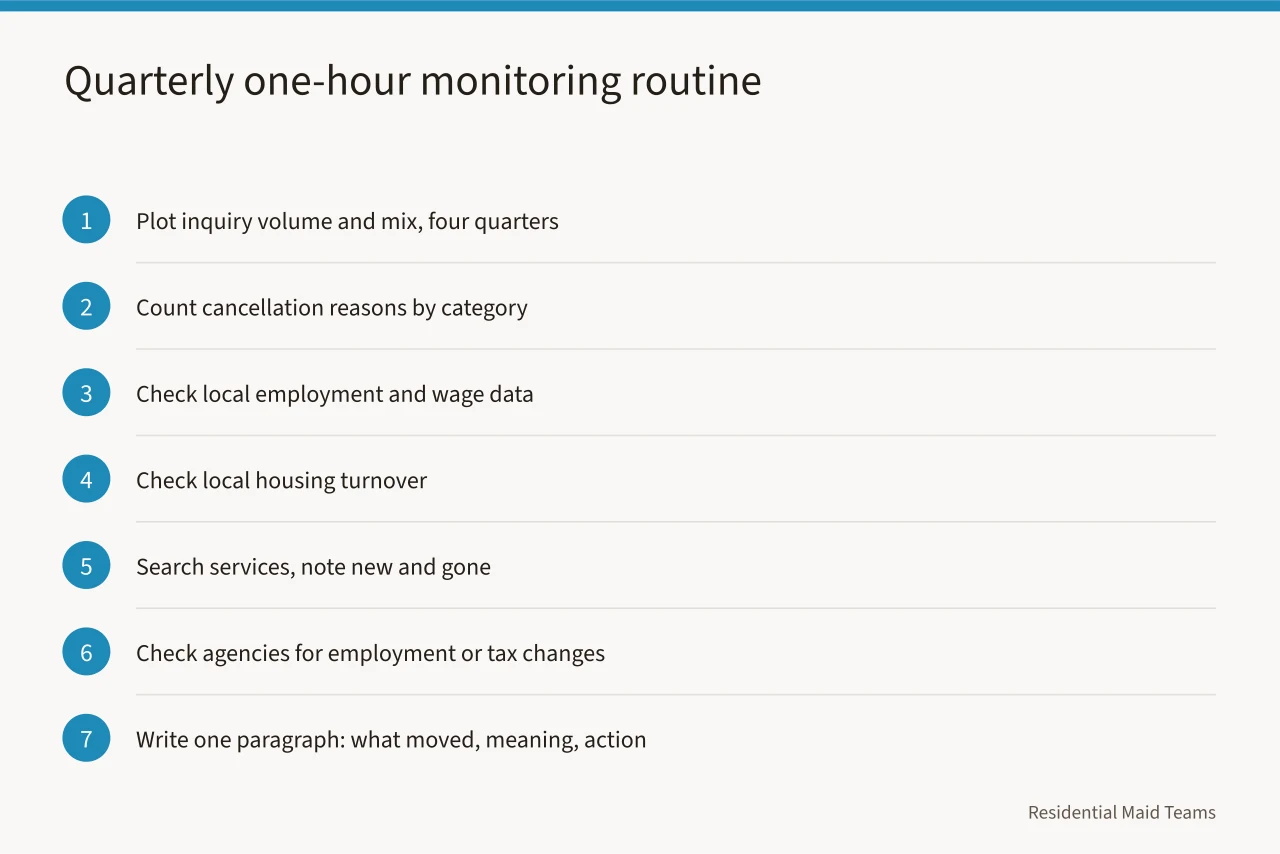
- Plot your own inquiry volume and mix for the last four quarters.
- Read the cancellation reasons and count them by category.
- Check local employment and wage data for your metropolitan area.
- Check local housing turnover.
- Search your services as a customer and note who is new, who is gone, and what the reviews complain about.
- Check the agencies for anything that changes employment or tax obligations.
Then write one paragraph: what moved, what you think it means, and what you will do. Keep the paragraphs. Four of them make a picture that no single quarter shows.
Decide the responses in advance
The point of monitoring is to convert a slow signal into an early decision. Write these down before you need them.
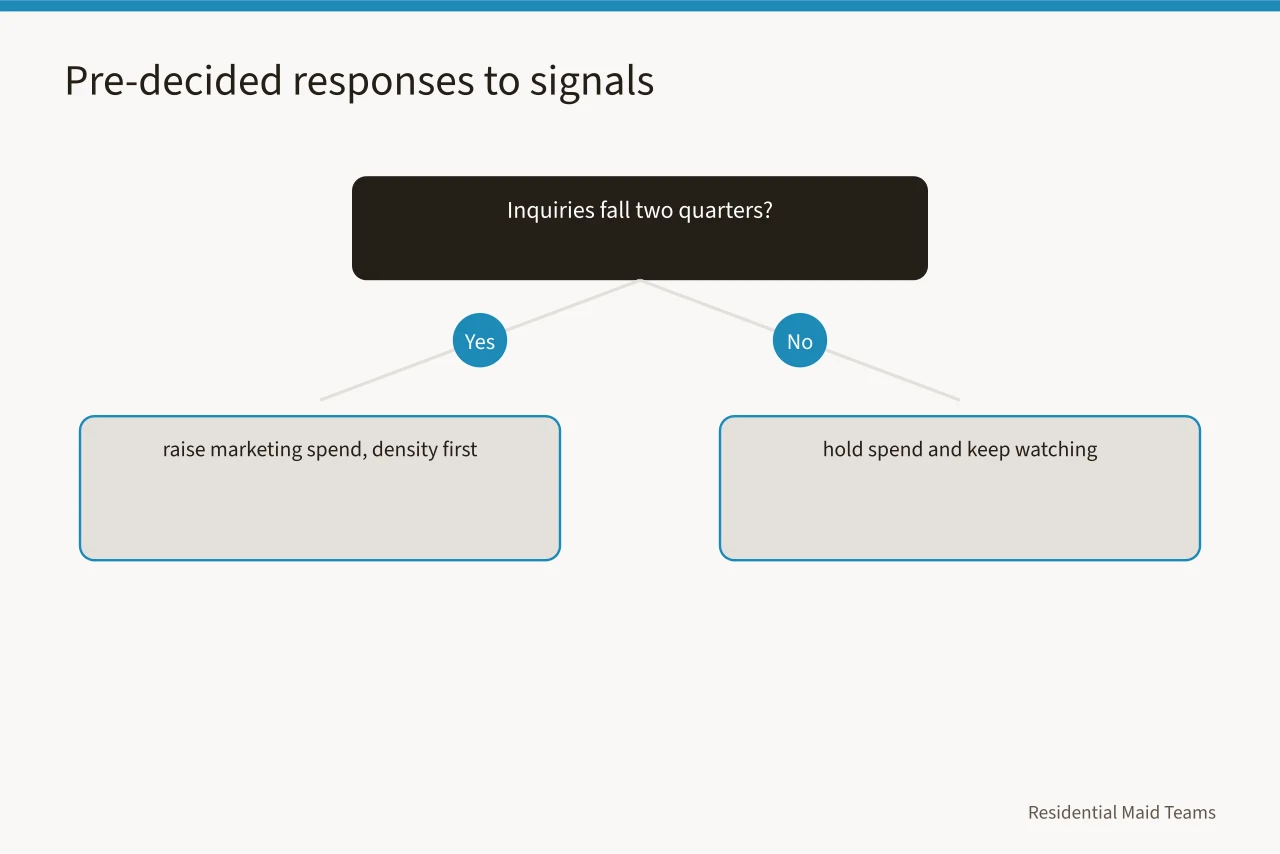
- If inquiries fall for two consecutive quarters: which marketing spend rises, and where. Density before geography.
- If the mix shifts from recurring to one-time: whether you introduce a lower-frequency package rather than discounting the existing one.
- If cost-driven cancellations rise: which is likelier to hold customers, a frequency option or a reduced scope at a lower price. Both are better than a quiet discount.
- If recruiting gets harder: what you change first. Usually schedule predictability and time to offer, before pay.
- If a competitor exits: how quickly you can absorb their customers, and whether you would hire their cleaners.
- If a regulation changes your cost base: how the price moves, with what notice, and in what words.
Deciding these in a calm quarter is worth far more than deciding them in an urgent one.
Durable pressures worth planning for
Some things move slowly enough to plan around, and they are structural rather than fashionable.
Labor is the binding constraint. In most markets the limit on a cleaning company's growth is people rather than customers, and everything that reduces turnover has a compounding return. That makes labor supply and training a strategic question rather than an administrative one.
Households increasingly ask what is used in their home. Questions about products, allergies, pets and ventilation are routine now. Answer them from the product label and safety data sheet rather than from a marketing claim, and note that the same chemistry raises exposure for your own crews. The hazards involved are set out in the Occupational Safety and Health Administration: Cleaning Industry overview.
Information about you is public and permanent. Reviews, response times and complaint handling are visible before anyone calls, which raises the return on reliability and lowers the return on advertising.
Route economics decide margin. Whatever demand does, a dense route earns more per crew hour than a scattered one. That does not change with any trend.
Turning a signal into a decision
A signal is not a plan. Two more steps.
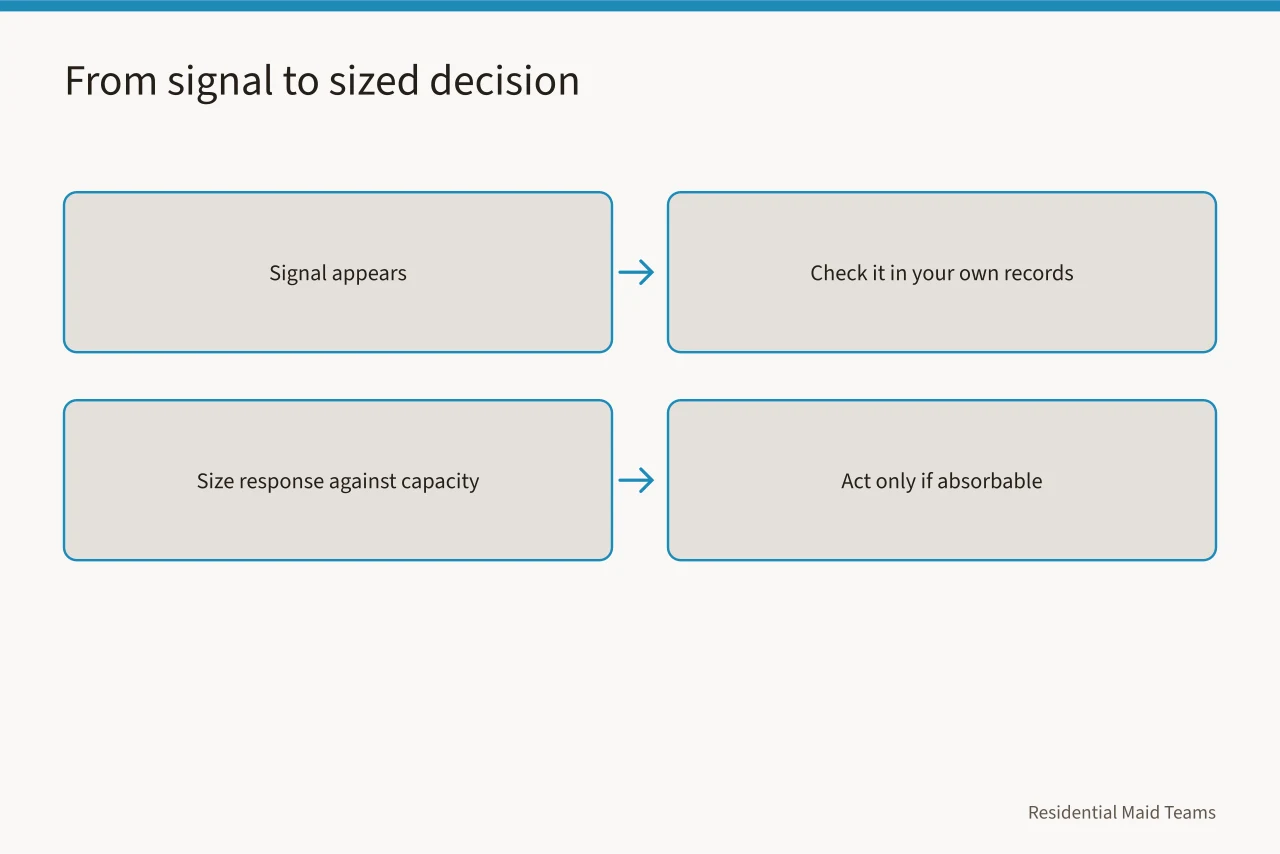
First, check whether it is visible in your own records. A national story that does not appear in your inquiry data is not yet your problem, and acting on it is expensive.
Second, size the response against capacity. Extra demand you cannot serve produces poor reviews and burned referral sources, which costs more than the revenue. What your operation can absorb is a property of operations that absorb the change rather than of the opportunity.
For the general planning and financing groundwork behind any response, including free counseling that will work through a change with you, the U.S. Small Business Administration: SBA Business Guide collects the federal resources. Whether the area itself still suits your model is worth re-running through the cleaning business market test every year or two.
Common questions
Is residential cleaning demand growing?
Nobody can answer that for your area, and the national answer would not tell you what to do next. Watch your own inquiry volume and local employment, and treat those as the real signal.
Should I add eco-friendly services because customers ask?
Ask how many are actually asking, in your own inquiry records, before restructuring anything. If it is real, choose products on performance and label instructions, keep the safety data sheets, and be careful what you claim, because environmental claims carry substantiation obligations.
Will technology change this trade?
Scheduling, communication and payment have already changed and continue to. The cleaning itself is performed by people in homes, and nothing on the horizon changes that. Invest in the systems, not in predictions about the work.
How far ahead should I plan?
Plan capacity a quarter ahead, hiring two quarters ahead, and geography a year ahead. Anything further is a hypothesis rather than a plan, and it should be written as one.