
Guides
Independent Contractor vs Employee for a Residential Maid Team: The Real Tradeoffs
Independent contractor vs employee house cleaning for residential maid teams: IRS tests, state unemployment risk, and the tradeoffs before you pay anyone.
What to take away
- The IRS and the Department of Labor use different tests, but both look at control, dependence, and the relationship between the owner and the cleaner.
- W-2 employees give you scheduling control and brand consistency, but you withhold taxes, pay unemployment insurance, and carry workers' compensation.
- 1099 contractors reduce payroll work, but you lose direct control and face misclassification risk if the cleaner acts like an employee.
- No classification removes the need for written scopes of work, insurance, and task expectations.
For a residential maid team, the choice between an employee and an independent contractor changes who controls the work, who carries the risk, and who pays employment taxes. Every owner should decide the legal structure before the first cleaner walks into a home.
The classification tests in plain terms
The IRS groups worker classification around behavioral control, financial control, and the type of relationship between the business and the worker. You can read the IRS criteria on its independent contractor or employee page.
The Department of Labor applies an economic realities test under the Fair Labor Standards Act. Fact Sheet #13 explains that this test focuses on whether the worker is economically dependent on the employer.
State unemployment insurance agencies often use an ABC test that is stricter than the IRS test. A cleaner can pass federal contractor rules and still be an employee for state unemployment tax.
The criteria that matter for a maid team
Use these criteria to compare the two structures side by side.
| Criterion | W-2 employee | 1099 contractor |
|---|---|---|
| Schedule control | Owner sets shifts, routes, and arrival windows | Cleaner sets own availability and accepts jobs |
| Tools and supplies | Owner provides equipment and products | Cleaner brings her own supplies |
| Payment | Hourly or salary, payroll taxes withheld | Flat per job, no withholding |
| Client ownership | Clients belong to the company | Cleaner may serve other clients |
| Training | Owner trains cleaner to company standards | Cleaner uses own methods |
The more control an owner keeps, the more the classification looks like W-2.
W-2 employees: control with a payroll trail
A W-2 employee fits a maid team that sends cleaners to homes under a common brand. The owner sets the schedule, provides the caddy and supplies, and trains the cleaner on repeatable steps. For the owner, money moves to gross wages, employer payroll taxes, and state unemployment and workers' compensation. A payroll provider handles federal income tax, Social Security, and Medicare withholding.
Expect a few days to open a state unemployment account and a workers' compensation policy before the first payroll run. For the federal filing steps in one place, see IRS and DOL rules for hiring.
1099 contractors: flexibility with a red flag
A 1099 contractor fits a cleaner who already runs her own business. She brings supplies, sets her own hours, files her own taxes, and carries her own insurance. The owner pays a flat rate per job and does not withhold income tax, Social Security, or Medicare. If the owner pays at least $600 in a year to a non-corporate contractor, the owner must file Form 1099-NEC.
But many maid teams start with that model and then drift. The owner begins assigning windows, offering supplies, and telling the cleaner which rooms to rotate first. This is the point where the contractor starts acting like an employee.
Where each one wins
A W-2 employee is the right choice when you want a repeatable brand, a fixed service standard, and the ability to send any trained cleaner into today's job. It also works when you plan to grow beyond two or three homes a week and need stable coverage.
Before moving a cleaner to a formal employee role, use a training checklist for home cleaning staff. The checklist helps you see whether the role needs ongoing direction or can be handed off.
A 1099 contractor is the right choice when the cleaner genuinely runs a separate business. She markets herself, invoices you, brings her own equipment, and decides which jobs to take. This model fits overflow work during busy seasons or a cleaner who already carries general liability insurance.
What none of them solve
Both structures leave one problem untouched: the actual quality of the clean. A properly classified employee can still streak a mirror, and a properly classified contractor can still ignore a pet-hair request.
What nobody mentions until afterwards: an owner can pass an IRS audit and still lose a state unemployment hearing because the agency applied a stricter ABC test.
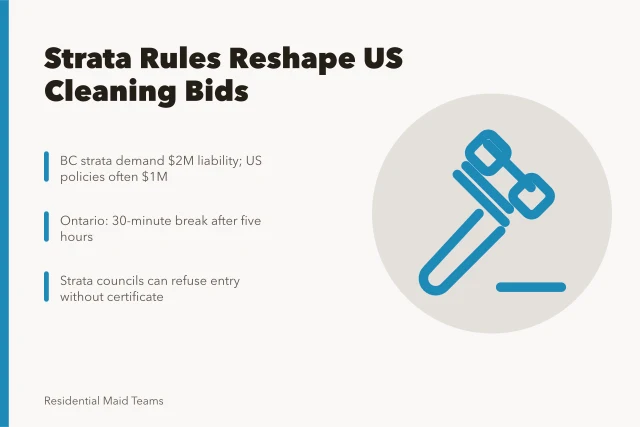
That shared limitation means owners need written scopes of work, photo checklists, and insurance, regardless of the classification. Trust and repeat business depend on this. For how trust turns into steady jobs, see referral engine inside. In many metros, a building board also wants proof of insurance and a written scope before the team enters. HOA and condo rules shape those contracts before the first walk-through.
Common questions
Does my state use the same test as the IRS? No. Many states use a stricter ABC test for unemployment. A cleaner classified as a contractor under IRS rules may still be an employee for state unemployment tax.
Do I have to give a 1099 to every cleaner? Only if you pay the cleaner at least $600 in the year and the cleaner is not incorporated. Payments to corporations often do not require a 1099-NEC.
Can a written contract make someone an independent contractor? A contract alone does not control. Agencies look at actual behavior, including who sets the schedule and who supplies the tools.
When should I switch a contractor to an employee? Switch when you begin assigning specific arrival windows, training cleaner methods, providing all supplies, or limiting the cleaner's other clients. Those facts signal employment.