
Guides
What to Include in a Residential Cleaning Service Agreement (Before the First Clean)
Residential cleaning service agreement terms: include cancellation policy, late payment, and liability limits under US state law before the first clean.
What to take away
- A residential cleaning service agreement terms sheet should state cancellation windows, late payment consequences, and liability limits before the first clean.
- State law caps late fees and cancellation charges; municipal and private rules can add proof of insurance or entry approvals.
- Submit the signed agreement, certificate of insurance, and any required license or approval before the date of service.
- Skipping a required city or HOA approval can void the agreement and trigger a consumer protection complaint.
State, municipal and private rules
Every residential cleaning service agreement sits under three layers of authority. State contract and consumer protection law sets the outer boundary for late fees, cancellation refunds, and damage liability waivers. Municipal rules, such as a business license or local consumer affairs code, can require registration before you advertise or clean. Private rules from a condominium board, HOA, or building manager can require a certificate of insurance, a background check confirmation, or an approved vendor form. Each term in the agreement still must satisfy the basic elements of a contract under common law, including offer, acceptance, and consideration.
| Layer | Common source | What it controls |
|---|---|---|
| State | Attorney general, civil code | Late fee caps, cancellation rights, damage waiver limits |
| Municipal | City clerk, local consumer affairs | Business license, notice periods, local claim rules |
| Private | HOA, condo board, property manager | Entry approval, insurance minimums, cleaning site rules |
What triggers a permit or written approval
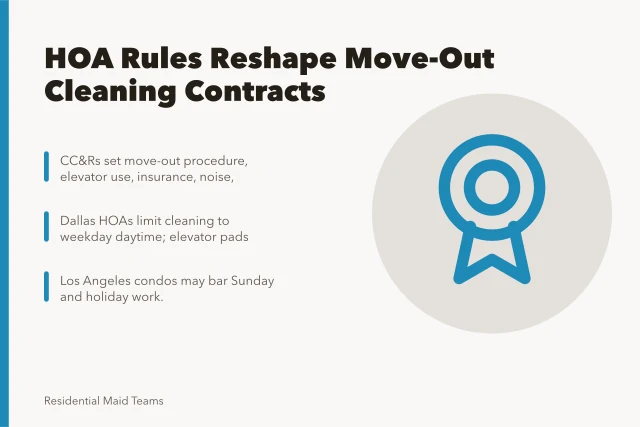
A general house cleaning rarely needs a building permit. A permit or written approval is more likely when the job includes construction debris removal, a hoarding cleanup that crosses into biohazard work, or a chemical treatment that requires special disposal. Some cities treat move-out cleaning inside a condo tower as vendor work, so the property manager must issue a vendor pass or work order before the cleaners arrive. The agreement should name which approvals the customer must obtain and which ones the cleaning company brings. When a condo or HOA requires vendor approval, the agreement should refer to that private rule; HOA and condo rules in US metros explains how those rules change move-out jobs.
If a job will involve a solvent or disinfectant beyond routine use, the agreement should list the product and reference OSHA rules for that chemical; OSHA chemical safety rules covers what a small team must document.
What to submit with the service agreement
Before the first clean, the cleaner should give the customer or property manager a small packet. This packet is not the same as a permit application, but many buildings and city agencies ask for the same items. Gather these documents.
- The signed service agreement with the address, date, scope, and cancellation policy.
- A certificate of insurance showing current general liability coverage.
- A city business license or DBA registration, if the municipality requires one.
- The customer's written confirmation that any HOA or building approval is complete.
The agreement cannot settle worker classification by calling someone a contractor. The IRS applies behavioral and financial control factors when deciding whether a cleaner is an employee or independent contractor. The DOL's economic realities test examines who controls the work and who bears the chance of loss.
Cancellation policy terms that hold up
A cancellation policy should state how many hours or days of notice the customer must give. It should also say whether a late cancellation means a charge, a rescheduled visit, or no charge. Many states allow a cleaning company to keep a deposit or charge a cancellation fee only if the agreement was clear and the amount reasonably relates to the actual loss. A clause that says all deposits are nonrefundable may fail in a state that requires refunds minus actual damages. Use a short cancellation window, a stated notice method, and a written acknowledgment.
A cancellation fee is enforceable in most US states only if the agreement states the amount or formula before the first clean and the fee is not a penalty.
The cancellation terms should appear on the same page as the quoted scope; home cleaning quotes shows how to line them up.
Late payment clause and state limits
A late payment clause for cleaners must respect state late fee caps and notice requirements. Some states limit late fees to a fixed amount or a percentage of the unpaid balance, while others allow only actual collection costs. The clause should say when a payment is late, how the customer will be notified, and what charge, if any, will be added. Do not write that a late fee will be assessed at the company's discretion; some state courts read that as an unenforceable penalty.
Liability limits and damage claims
A cleaning company may want to limit liability for pre-existing damage, wear and tear, or claims made after the crew leaves. State law often prohibits a broad waiver of liability for the cleaner's own negligence. A clause that says not responsible for any damage is usually not enforceable for damage the crew caused. Instead, the agreement should ask the customer to report damage within 24 or 48 hours and state that the cleaner will repair or pay for proven damage. Photographs before and after work are the best evidence, but they are not a substitute for a written clause.
Worker status affects liability and insurance; IRS and DOL rules for hiring US residential cleaners gives the federal test.
How long approval takes
For city business licenses or DBA registrations, approval often takes 5 to 15 business days after filing. HOA or condo vendor approval can take longer, sometimes 7 to 30 days if the board meets monthly. The agreement should list the approval status as a condition of service. Do not book a first clean until the written approval, when one is required, exists in hand.
What happens if you skip a required approval
If you skip a required HOA vendor approval or a city business license, the cleaning company can be barred from the property, fined under a municipal code, or named in a consumer protection complaint. In a worst case, the agreement itself may be treated as void for that job, leaving the company with no enforceable payment claim. One concrete consequence: in some cities, operating without a required business tax registration can lead to a cease-and-desist order from the local consumer affairs office.
Common questions
What makes a cancellation policy enforceable? It must state the notice period, method, and consequence before the first clean, and the charge must not be a penalty under state law.
Can I charge a late fee without a written clause? Usually not. A court will not add a late fee to a service agreement unless the agreement says the customer agreed to it.
Do I need a lawyer to draft a cleaning service agreement? Not always, but a state consumer protection attorney can confirm the cancellation and late fee language for your city.
Is a signed agreement required before the first clean? Yes, even a one-page agreement protects the cleaner if a customer disputes scope or damage.