
Guides
When Does a Residential Maid Team Need Workers' Comp? State-by-State Guide
Workers' comp for residential cleaners hinges on state employee thresholds. This guide maps when a maid team must buy coverage and the risks of skipping it.
What to take away
- Workers' comp for residential cleaners starts with state employee thresholds, which range from one worker in California to no private-employer mandate in Texas.
- Using independent contractors does not end the question if the cleaners meet the IRS and DOL employee tests.
- State exemptions for domestic workers or family members can reduce the trigger, but municipal permits and private contracts may still require proof of coverage.
- Skipping required coverage can bring a stop-work order and personal liability for an injured cleaner's medical costs.
State workers' compensation law, not a single federal rule, decides when a residential maid team must carry coverage. Most states require employers with one or more employees to buy a policy, but the definition of employee changes across state lines. The answer starts before the first clean, because classification and exemptions drive the obligation.
Who has jurisdiction
State law sets the floor. Municipalities rarely create their own workers' comp rules, but city licensing may ask for proof of insurance. Private rules from clients, homeowner associations, or franchise agreements can also demand coverage even when state law does not. For example, a condo board may require a certificate of workers' comp before allowing cleaners into common areas. The U.S. Department of Labor's workers' compensation page links to each state program, where the binding requirements live.
What triggers coverage
Coverage generally starts when a business has one or more employees. Some states exempt domestic service, casual labor, or certain family members. A sole owner with no employees has no obligation in most states, but hiring even one part-time cleaner can trigger a requirement in California, New York, and others.
Texas remains the outlier: private employers are not required to carry workers' comp, though they can choose to opt in. An injured worker in Texas may sue the employer in civil court, while employers with coverage get tort protection in many states.
| State | Private employer trigger | Residential cleaning note |
|---|---|---|
| California | One or more employees | Domestic workers are covered after a short quarterly hour threshold. |
| Texas | No mandate for most private employers | Opting in gives tort protection; without it, worker may sue. |
| New York | One or more employees, with narrow exemptions | Coverage required from first day of employment in most cases. |
| Florida | Four or more employees | Non-construction threshold; sole proprietors and partners exempt. |
Worker classification is the threshold question. A cleaner who uses your supplies, follows your schedule, and cannot profit or lose from the job is likely an employee, no matter what the contract calls her.
The IRS and DOL rules for hiring US residential cleaners as employees or contractors explain how the economic realities test applies to a team member who cleans only one client's home. The IRS independent contractor criteria apply behavioral and financial control tests. The DOL Fact Sheet #13 applies the economic realities test.
What to submit
When applying for a workers' comp policy, a residential maid team owner typically needs payroll records, a list of job duties, the business's FEIN, and prior loss history, if any. The insurance carrier or state fund will ask whether the cleaners are employees or independent contractors.
In some states, the application must include a certificate of insurance from a licensed carrier, not just a binder. For example, New York requires employers to obtain coverage from an insurance carrier, the state insurance fund, or self-insurance. A written Residential Cleaning Service Agreement can state which party carries workers' comp for subcontractors, but it cannot override a state statute that defines the cleaner as an employee.
How long approval takes
Approval speed depends on the carrier and the payroll size. A standard policy can be bound the same day when payroll is simple and the owner has no prior claims. A state fund application may take two to four weeks when underwriting asks for classification details or a safety plan. Start the process before the first payroll run, not after an injury.
Example: Texas versus California
A two-person residential maid team in Austin has no state mandate to buy workers' comp, but a large condo client may require it as a condition of access. The same two-person team in San Diego must have coverage from the first employee hired, unless the workers meet a narrow domestic service exemption.
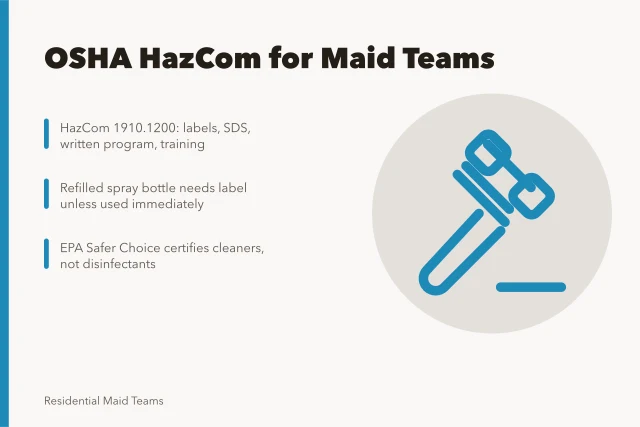
The same team should also follow OSHA chemical safety rules for US residential maid teams, explained, because hazard communication rules apply regardless of workers' comp thresholds. Each state's workers compensation for house cleaners program uses its own employee definition and exemption list.
What happens if you skip it
The consequences are practical, not just administrative. In California, the Division of Workers' Compensation can issue a stop-work order that shuts down the cleaning operation until coverage is in place. Without coverage, an injured cleaner can file a civil suit, and the owner may be personally liable for medical bills and lost wages. A client who required a certificate of coverage and discovers none may terminate the contract immediately. Municipal permits can also be denied or revoked if the business cannot show required insurance.
A stop-work order is a hard stop, not a request. It means no cleaners may enter client homes until the policy is active and proof is filed.
A training checklist can lower the chance of residential cleaning workplace injuries, but it does not replace a state-required policy.
Common questions
Does a sole owner cleaning alone need workers' comp? In most states, no. A sole proprietor with no employees is exempt, but private clients or a city license may still ask for proof. What if I classify all cleaners as independent contractors? The IRS and DOL rules still apply. If the cleaners work under your direction and cannot lose money on the job, they are likely employees, and the state may require coverage retroactively. Are family members counted as employees for workers' comp? Some states exclude spouses, children, or parents from coverage requirements, but the exemption is not uniform. Check your state fund's definition before relying on it. Does workers' comp cover residential cleaning workplace injuries like chemical burns or falls? Yes, when coverage exists. It pays medical treatment and a portion of lost wages for injuries that arise out of employment, including chemical exposure and slip-and-fall injuries in clients' homes.