
Guides
How to decide between new and used home cleaning equipment for a small operation
New vs used home cleaning equipment settled by arithmetic: a cost-per-productive-hour formula, the downtime term most buyers omit, and what never to buy used.
What to take away
- Compare on cost per productive hour of ownership, not on purchase price. The formula below has five terms and you can fill it in from quotes.
- The term that decides most comparisons is downtime, and it is the one nobody includes. A cheap machine that is out of service costs a crew's day.
- Used is usually right for equipment with a large, cheap parts supply and a simple failure mode. New is usually right where a failure stops a job.
- Never buy used personal protective equipment, and never buy any chemical product without an intact label and a safety data sheet.
- Ask for the maintenance history. A used machine with no history is priced as though it has none.
No prices, depreciation rates or resale figures appear here, because they would be invented. Every input to the formula comes from your own quotes and your own job records.
The comparison that matters
Purchase price is the wrong basis. Two machines can differ by a factor of three on price and by almost nothing on what they cost you over the years you own them.
Cost per productive hour
New unit
- Purchase price P
- Higher
- Maintenance M
- Supplier schedule
- Downtime D
- Usually lower
- Resale R
- Often zero
- Productive hours H
- Same period
- Formula
- (P+M+D-R)/H
Used unit
- Purchase price P
- Lower
- Maintenance M
- Supplier schedule
- Downtime D
- Usually higher
- Resale R
- Often zero
- Productive hours H
- Same period
- Formula
- (P+M+D-R)/H
The honest comparison is cost per productive hour of ownership. Define:
- Pfor the purchase price, including delivery, any immediate service, and sales tax.
- Mfor expected maintenance and parts over the holding period, taken from the supplier's stated schedule rather than from optimism.
- Dfor downtime cost: expected days out of service over the holding period, multiplied by the contribution a crew produces in a day.
- Rfor expected resale or residual value at the end of the period, which is often zero for cleaning equipment and should be treated as zero unless you have evidence.
- Hfor productive hours the machine will actually be used over the holding period.
Cost per productive hour is:
(P + M + D - R) / H
Run it for the new unit and for the used one, using the same holding period, and compare the two numbers. Most disagreements about new versus used dissolve when both sides fill in D.
Estimating the downtime term
This is the term people skip because it feels unknowable. It is not.
Does downtime flip the answer?
Do you hold a spare unit?
downtime near zero, used wins
one failure can cost more than the saving
Ask the supplier two questions: what is the shipping time for the parts that fail most, and where is the nearest service center. Then estimate days out of service per year, multiply by the holding period, and multiply that by what a crew day contributes.
Two sanity checks. If you hold a spare unit, downtime falls close to zero and the used machine looks much better. If you hold no spare, a single machine failure can cost more in one week than the price difference saved, and the arithmetic flips.
That is the real finding: whether to buy used is partly a question about whether you own spares, which is a different purchase decision entirely. The interaction between the two sits inside the home cleaning equipment specification.
Whether to buy used is partly a question about whether you hold spares. With a spare on the shelf the downtime term collapses and used wins easily; with none, a single failure can cost more in a week than the saving.
Where used generally wins
Used tends to win where three conditions hold together: parts are cheap and widely available, failure is gradual rather than sudden, and the item is not customer-visible.
- Commercial upright and canister vacuums from long-running model lines, where belts, filters and brush rolls are stocked everywhere.
- Buckets, carts, caddies and hard-wearing plastic goods, which are worth almost nothing used and last a long time.
- Step stools and ladders, if and only if they are physically inspected and undamaged.
- Specialty equipment for a service you run occasionally, where the alternative is a new machine that sits idle most of the month.
- Vehicles, where a documented service history exists and where the residual value is genuinely realizable.
Where new generally wins
- Anything whose failure stops a job and for which you hold no spare.
- Machines where the current model has a materially better filtration or ergonomic design, because both of those turn into costs you will pay in complaints or injuries.
- Anything under warranty coverage you actually intend to use.
- Equipment for a service you have just launched, where an unreliable machine will be blamed on the service rather than on the machine.
What never to buy used
This list is short and it is absolute.
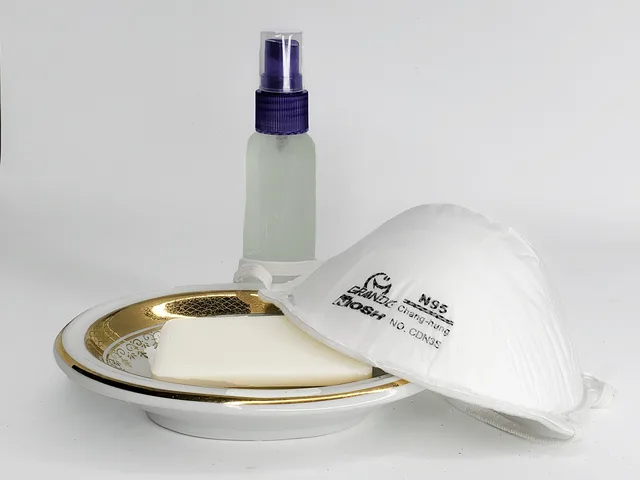
- Personal protective equipment.Gloves, eye protection and respirators degrade in ways you cannot see, and their protective value is the entire point of owning them.
- Any chemical product without an intact original label and an available safety data sheet.Employers carrying hazardous chemicals are responsible for a written hazard communication program, labels and warnings, accessible safety data sheets, and training on the hazards, as set out in the Occupational Safety and Health Administration: Hazard Communication Standard. An unlabeled second-hand container fails all of that at once.
- Damaged electrical equipment.A frayed cord or a cracked housing on a machine used around water is not a bargain.
- Ladders or stools with any structural damage.
- Anything a supplier will not identify by model and year, because you cannot check parts availability for a machine you cannot name.
The wider hazard picture behind items one, three, and four includes electrical and ergonomic exposures specific to this trade. The Occupational Safety and Health Administration: Cleaning Industry overview describes it.
Purchasing decisions are one place where a safety program is applied or quietly ignored. The Occupational Safety and Health Administration: Safety Management material sets out the structure for applying it consistently.
The inspection, before you hand over money
For any used machine, do all six of these in person.
Six-point used machine inspection
- Identify exact model and year
- Run ten minutes under load
- Open the filter housing
- Flex full cord, inspect plug
- Check brush roll, belt, wheels
- Ask for maintenance history
- Identify the exact model and year, then check parts availability yourself rather than taking the seller's word.
- Run it for at least ten minutes under load and listen for bearing noise.
- Open the filter housing. What you find there tells you how the machine was treated.
- Flex the full length of the cord and inspect the plug and the strain relief.
- Check the brush roll, the belt and the wheels for wear.
- Ask for the maintenance history and treat its absence as a price reduction rather than as a detail.
Financing changes the answer
If the choice is between new on finance and used for cash, add the finance cost to P and compare again. Sometimes new still wins. Often the used unit plus a spare of the same model beats a single financed new one, because two machines with one spare has near-zero downtime and the finance cost disappears.
Whichever way it lands, record the equipment cost against the jobs it serves so the ownership cost shows up per service line rather than as a lump in overhead. The capital assumptions belong in the plan's capital section alongside the rest of the opening spend.
Three practical cautions
Training time is a cost of buying unfamiliar equipment. A machine nobody on the crew has used needs instruction before it goes into a home, and training time on unfamiliar machines is real hours that belong in the comparison.
Coverage conditions can constrain the purchase. Some policies and some client contracts carry requirements about equipment condition or vehicle use, so check the coverage and compliance conditions before committing to a second-hand vehicle in particular.
Do not let a bargain change the specification. If a used unit does not meet the specification you wrote, it is not a cheaper version of the right machine, it is the wrong machine at a discount. Start from the new owner's cleaning equipment list rather than from what happens to be available.
Common questions
Is buying used a false economy for a new company?
Not as a rule. It is a false economy for anything whose failure stops a job when you hold no spare, and a genuine saving for durable goods with a deep parts supply. The formula sorts them without needing a rule.
How long should the holding period in the formula be?
Long enough to cover a realistic service life for the class, and the same for both options. Using three years for the new unit and one for the used one is the most common way people accidentally get the answer they already wanted.
Where do used machines come from?
Commercial cleaning companies replacing fleets, equipment dealers with trade-ins, and auctions. Dealers cost more and can usually identify the model, supply parts and stand behind a basic service, which is worth the difference on anything mechanical.
What if I cannot estimate the downtime cost?
Use a crew's daily contribution as a placeholder and vary it up and down. If the comparison flips within a plausible range, buy the more reliable option, because you have just learned that the decision is dominated by uncertainty you cannot reduce.